Short answer: not for the ghats, and yes for almost everything else.
That is a more useful answer than it sounds, because the two halves of Varanasi work completely differently. One of them explains itself, and one of them does not explain itself at all.
Where you genuinely do not need a guide
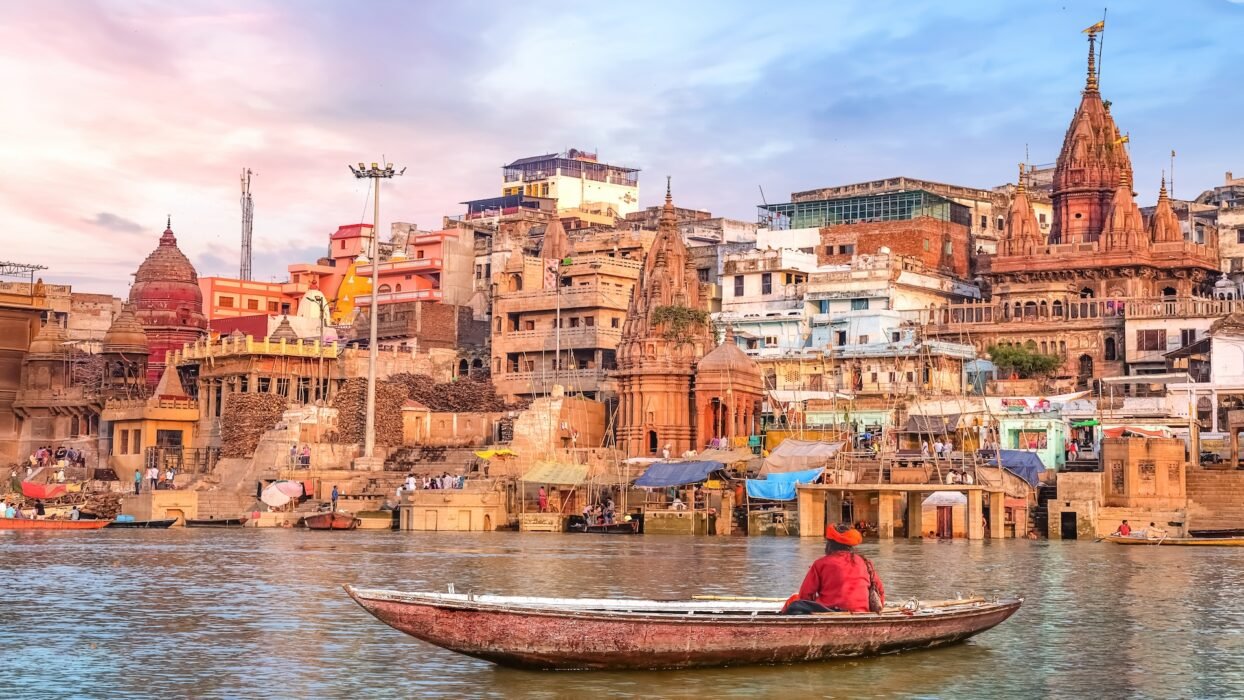
Walking the ghats. Seven kilometres of riverfront, in a line, with the river on one side. You cannot get lost, and there is nothing to decode. People are bathing, washing, praying, sitting. Walk it slowly, stop where you want, and let it happen. A commentary would get in the way.
The sunrise boat. The boatman takes you out, and the light does the rest. A guide makes it better — more on that below — but the hour works perfectly well without one.
Getting lost in the old city. This is the thing everyone remembers, and it only works if nobody is steering you. Go in without a plan, accept that you will come out somewhere unexpected, and do not let anyone rescue you from it.
Eating. You want a queue of local people, not an interpreter. Stand where they stand.
If your trip is four or five unhurried days and the ghats are what you came for, you can do a great deal of Varanasi alone.
Where a guide changes the trip entirely
Temples. Nothing in a Hindu temple is labelled. There is no plaque telling you which form of the deity this is, why people are circling clockwise, what the offering in that man's hands is for, or why this particular shrine among the three thousand in this city. You can stand in the most significant temple in Hinduism and leave having seen a queue and a crowd.
Sarnath. This is the strongest case of all. What is physically at Sarnath is a brick stupa, a broken pillar and some foundations. What happened there is the beginning of Buddhism as a community — five men who had abandoned the Buddha, one of whom understood the teaching as it was spoken. None of that is visible. Visitors routinely give Sarnath forty-five minutes and leave underwhelmed, and that is almost entirely a guiding problem.
Kashi Vishwanath. Not for meaning so much as for logistics. Which gate, which queue, what you cannot carry in, where the cloakroom is, what time to go. People lose a morning to this.
Manikarnika. Here, a guide is partly about knowing how to behave. Where to stand, how far back, what not to photograph, and how to recognise the donation request that is not what it claims to be. Causing offence at a cremation ground is easy to do by accident.
A short trip. With two days, a guide buys you time. Without one you will spend a good portion of it working out where things are and how to get there.
The benefit nobody mentions
A guide stops the approaches.
Alone in Varanasi you will be offered a boat, a guide, silk, hashish and a blessing, repeatedly, all day. It is persistent rather than threatening, and by the second afternoon it is wearing.
Walking with someone local ends it almost completely. Touts do not approach a visitor who already has a guide, because there is nothing to sell. Several of our guests have said afterwards that this was the thing they valued most, which was not what they expected when they booked.
The kinds of guides, and which to avoid
Licensed guides. Government-certified, trained in the history, usually working in English and sometimes in European or East Asian languages. The most reliable option, and the one most likely to actually know what happened at Sarnath.
Guides arranged through your accommodation or an operator. Accountable to somebody, which matters. If it goes wrong, there is a person to tell.
Someone who attaches themselves to you. This is where the complaints come from. A man falls into step at a temple entrance, provides commentary you did not request, walks with you for an hour, and presents a figure at the end that you did not agree to. There is no recourse because there was never an arrangement.
The "free" guide. Nobody works for nothing. If no money is being discussed, the money is coming from a silk emporium at the end of the walk, and the amount of time you spend in it will not be up to you.
What to ask before you agree
The shop's question is the important one. Ask it directly and watch the answer.
On language
Most guiding in Varanasi is available in English and Hindi. Beyond that it thins out quickly, which is a real problem in a city that draws pilgrims from every part of India and visitors from across the Buddhist world.
If your parents are more comfortable in Tamil, Telugu, Marathi, Bengali or Gujarati, or if you are coming from Japan, Thailand or Korea for the Buddhist sites, ask about language before anything else. It changes the day more than any other single factor.
Our Sāthi guides work across fifteen languages. Tell us which you need and we will tell you honestly whether we can cover it for your dates.
How much guiding do you actually need?
Most people over-buy or under-buy, and the sensible shape is usually in between.
A half day covering the temples and the old city lanes, which is where the meaning is densest and where you are most likely to be lost without help.
A separate half day for Sarnath, which deserves its own guide and its own pace.
The rest of the trip alone. The ghats, the walking, the food, the mornings. Those are better unaccompanied.
A guide for every hour of a five-day trip is more than most people want. A guide for none of it means seeing the outside of everything.
What it should cost
Rates vary by language, by whether the guide is licensed, and by half day or full day. What matters more than the figure is that it is agreed in advance, in full, and that you know whether temple entries, boats and transport sit inside it or outside it.
A quoted figure that turns into a larger one at the end of the day is the single most common complaint about guiding in this city, and it is avoidable entirely by asking two questions before you start.
How do we do it?
Our Sāthis are matched to what you are actually here for — a pilgrim performing rites and a photographer want different things from the same morning — and across fifteen languages.
The price is printed before you book, GST included, and settled in advance. Nothing is asked for at the end of the day. There are no shops on the route, because the people we work with are paid properly by us rather than by an emporium.
And we will tell you when you do not need us. If you have six days and the ghats are what you came for, we will suggest a half day for the temples, a morning at Sarnath, and the rest to yourself. That is usually the better trip, and it costs you less.